AI Customer Service Agent: What It Is, How It Works, and When to Use One
SEO Title: AI Customer Service Agent: What It Is, How It Works, and When to Use One
Meta Description: Learn what an AI customer service agent is, how it works, when to use one, and how businesses can automate support across chat, email, SMS, WhatsApp, Instagram, and phone.
Suggested URL Slug: /blog/ai-customer-service-agent
Primary Keyword: AI customer service agent
Secondary Keywords: AI customer support agent, customer service automation, AI customer service software, omnichannel AI support, AI agent for customer service, automated customer support
Customer expectations have changed. People no longer want to wait hours for a reply, repeat the same information across channels, or search through help-center articles just to solve a basic issue.
They want fast, accurate, personalized help wherever they already are: website chat, WhatsApp, Instagram, Messenger, SMS, email, or phone.
That is where an AI customer service agent comes in.
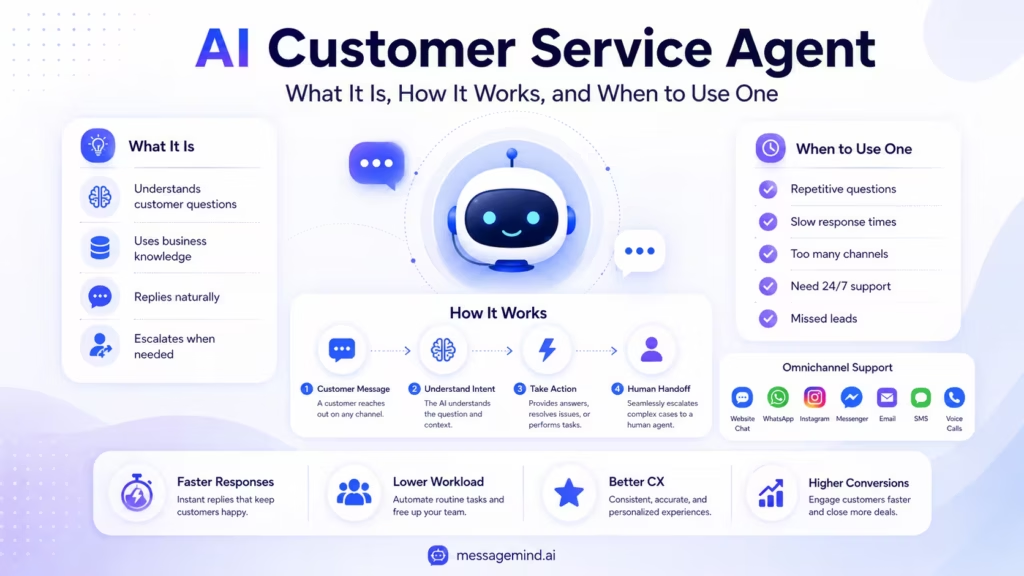
An AI customer service agent is not just a basic chatbot that follows a script. A modern AI agent can understand customer questions, use business data, reply in natural language, take actions through integrations, escalate complex cases, and support customers around the clock.
For growing businesses, this can mean faster response times, lower support costs, better lead capture, and more consistent customer experiences without hiring a larger support team.
In this guide, we will explain what an AI customer service agent is, how it works, when your business should use one, and what to look for before choosing a solution like MessageMind.
What Is an AI Customer Service Agent?
An AI customer service agent is software that uses artificial intelligence to communicate with customers, answer questions, resolve issues, and perform support-related tasks automatically.
Unlike traditional chatbots, which usually rely on fixed rules or pre-written decision trees, AI customer service agents can understand natural language, interpret context, and generate helpful responses based on your business information.
In simple terms:
An AI customer service agent is a digital support representative that can answer customer questions, assist with common requests, and hand off complex conversations to humans when needed.
A customer service AI agent can help with tasks such as:
- Answering frequently asked questions
- Recommending products or services
- Capturing and qualifying leads
- Handling order status questions
- Helping with returns, refunds, or cancellations
- Booking appointments or demos
- Responding to emails and messages
- Supporting customers across multiple channels
- Escalating sensitive or complex issues to a human team member
For example, if a customer asks, “Where is my order?” an AI customer service agent can understand the request, identify the customer, check order or shipping data through an integration, and respond with the relevant tracking information.
That is very different from a basic chatbot that simply says, “Please visit our tracking page.”
AI Customer Service Agent vs Chatbot: What Is the Difference?
Many businesses use the words “AI agent” and “chatbot” interchangeably, but they are not the same.
A traditional chatbot usually follows rules. It can answer predictable questions if the user clicks the right button or types the expected phrase.
An AI customer service agent is more flexible. It can understand open-ended questions, handle different phrasings, maintain context, and connect to tools or business systems.
Key Differences Between Chatbots and AI Customer Service Agents
| Feature | Traditional Chatbot | AI Customer Service Agent |
|---|---|---|
| Conversation style | Scripted | Natural and conversational |
| Setup | Rule-based flows | Trained on business data and instructions |
| Flexibility | Limited | Handles varied customer questions |
| Channels | Often limited to website chat | Can work across chat, email, SMS, social, and phone |
| Integrations | Basic or limited | Can connect with CRMs, ecommerce tools, calendars, and support systems |
| Escalation | Often manual | Can detect when to hand off to a human |
| Best for | Simple FAQs | Full customer service automation |
A chatbot may be useful for simple website questions. But if your business wants to automate real conversations across multiple channels, an AI customer service agent is usually the better fit.
That is especially true for companies that receive customer messages from many places, such as WhatsApp, Instagram, email, SMS, and website chat. With MessageMind’s digital AI agents, businesses can manage these customer conversations from one intelligent system instead of switching between disconnected inboxes.
How Does an AI Customer Service Agent Work?
An AI customer service agent works by combining natural language understanding, business data, conversation memory, integrations, and automation rules.
While each platform is different, most AI customer service agents follow a similar process.
1. The Customer Sends a Message
The conversation starts when a customer contacts your business through a supported channel.
This could happen through:
- Website chat
- Instagram DM
- Facebook Messenger
- SMS
- Phone call
- Lead form
- Booking form
For example, a customer might ask:
“Do you offer same-day delivery?”
“Can I change my appointment?”
“Is this product available in size medium?”
“I need help with my reservation.”
“Can I speak with someone about pricing?”
An omnichannel AI customer service agent can receive and respond to these messages across the platforms where your customers already communicate.
2. The AI Understands the Customer’s Intent
Next, the AI analyzes the customer’s message to understand what they are asking.
This process is often powered by natural language processing, which helps software interpret human language.
The AI looks for details such as:
- The customer’s question
- The intent behind the message
- The urgency of the request
- Relevant order, booking, product, or account details
- Whether the message should be automated or escalated
For example, the AI can tell the difference between:
“Where is my order?”
“Can I return this?”
“I want to cancel my subscription.”
“I am very upset and need a manager.”
Each message requires a different type of response.
3. The AI Uses Your Business Knowledge
A strong AI customer service agent does not guess. It should respond based on your approved business information.
That information may include:
- FAQs
- Product details
- Service descriptions
- Pricing rules
- Return policies
- Shipping policies
- Appointment availability
- Booking instructions
- Internal support guidelines
- Customer conversation history
- CRM or ecommerce data
This is where the quality of setup matters. The AI needs accurate knowledge, clear instructions, and guardrails so it can respond consistently.
For example, an ecommerce brand might train its AI agent on product catalogs, shipping policies, refund rules, and order-tracking workflows. A hotel might train its AI agent on check-in times, parking instructions, room policies, local recommendations, and booking information.
MessageMind is built for this kind of real-world customer communication. Businesses can use it to automate support across digital channels, email, and voice while keeping their customer experience consistent.
4. The AI Responds or Takes Action
Once the AI understands the request and has the right information, it replies to the customer.
Depending on the situation, it may also take action.
For example, an AI customer service agent may:
- Answer a question
- Ask a follow-up question
- Recommend a product
- Share a booking link
- Start a return process
- Provide order-tracking information
- Update a customer record
- Create a support ticket
- Schedule a meeting
- Route the conversation to the right team member
This is where AI customer service software becomes more powerful than a simple FAQ bot.
With the right integrations, an AI agent can connect customer conversations to business systems such as ecommerce platforms, calendars, CRMs, payment tools, and support workflows.
5. The AI Escalates When a Human Is Needed
AI should not replace human judgment in every situation.
The best AI customer service agents know when to hand off.
Human handoff is important when a conversation involves:
- Angry or frustrated customers
- Sensitive account issues
- Legal, medical, or financial concerns
- Complex refunds or disputes
- VIP customers
- Unusual requests
- Situations where the AI is not confident
A good AI customer support agent should make this transition smooth. The human team member should be able to see the conversation history, customer details, and context before replying.
This prevents customers from having to repeat themselves.
When Should a Business Use an AI Customer Service Agent?
A business should use an AI customer service agent when customer messages are increasing, response times are slowing down, or the team is spending too much time answering repetitive questions.
AI customer service agents are especially useful when your business needs faster replies, 24/7 availability, better lead capture, or support across multiple communication channels.
Here are the clearest signs that it may be time to use one.
1. Your Team Answers the Same Questions Every Day
If your team repeatedly answers questions like “What are your hours?”, “Where is my order?”, “How do I book?”, or “What is your return policy?”, those conversations are strong candidates for automation.
Repetitive questions are often the easiest and highest-ROI use case for an AI customer service agent.
Instead of making your team respond manually every time, AI can instantly answer common questions and free your team to focus on higher-value conversations.
2. Customers Expect Faster Responses Than Your Team Can Provide
Slow response times can cost you sales, bookings, and customer trust.
When someone messages your business, they may also be comparing competitors. If your team takes hours to respond, the customer may move on.
An AI customer service agent can respond instantly, even outside business hours.
This is especially valuable for businesses that receive messages in the evening, on weekends, or from customers in different time zones.
3. You Receive Messages Across Too Many Channels
Many businesses now receive customer inquiries from several places at once:
- Website chat
- Facebook Messenger
- SMS
- Phone calls
Managing all these channels manually can become chaotic.
An omnichannel AI customer service agent helps centralize customer conversations so your business can respond faster and more consistently.
MessageMind is designed for this exact challenge, helping businesses automate conversations across digital channels, email, and voice from one platform.
4. You Want to Offer 24/7 Customer Support Without Hiring 24/7 Staff
Hiring human agents for around-the-clock coverage can be expensive.
An AI customer service agent can help your business stay available 24/7 by answering common questions, collecting information, and escalating urgent cases when necessary.
This does not mean humans disappear from the process. Instead, AI handles the first layer of support while your team manages the conversations that truly require human attention.
5. You Are Losing Leads Because Follow-Up Is Too Slow
Customer service and sales are closely connected.
If someone asks about pricing, product availability, booking options, or service details, that conversation may be a sales opportunity.
An AI customer service agent can help capture and qualify leads automatically by asking the right questions, collecting contact details, and routing the conversation to your sales team when needed.
For service businesses, this can mean more booked appointments. For ecommerce brands, it can mean more completed purchases. For hospitality businesses, it can mean more direct bookings.
6. Your Support Team Is Growing but Costs Keep Rising
At a certain point, adding more support agents may not be the most efficient way to scale.
If ticket volume grows but many inquiries are repetitive, an AI agent can help reduce the workload without lowering service quality.
The goal is not to replace your entire team. The goal is to reduce unnecessary manual work so your people can focus on complex, sensitive, or revenue-generating conversations.
Best Use Cases for AI Customer Service Agents
AI customer service agents can support many industries, but they are especially useful in businesses with high message volume, repetitive questions, booking workflows, order inquiries, or lead qualification needs.
Ecommerce Customer Support
For ecommerce brands, an AI customer service agent can answer product questions, help customers choose the right item, track orders, explain shipping timelines, and support return or exchange requests.
Common ecommerce use cases include:
- “Where is my order?”
- “What is your return policy?”
- “Do you ship internationally?”
- “Is this product in stock?”
- “Can I change my shipping address?”
- “Which product is best for me?”
For online stores, customer service automation can directly affect revenue. Fast answers reduce friction and help customers make buying decisions.
Businesses selling online can explore MessageMind’s AI customer support for ecommerce to automate high-volume customer conversations while keeping the shopping experience personal.
Short-Term Rental and Airbnb Guest Messaging
Short-term rental operators often receive the same guest questions before, during, and after a stay.
An AI customer service agent can help answer questions about:
- Check-in instructions
- Wi-Fi details
- Parking
- House rules
- Early check-in
- Late checkout
- Local recommendations
- Maintenance issues
- Booking changes
This is a strong use case because guests often need quick responses outside normal business hours.
For property managers and Airbnb hosts, MessageMind for short-term rentals can help automate guest communication and reduce repetitive manual messaging.
Hotels and Hospitality
Hotels and hospitality businesses can use AI customer service agents to improve guest communication before arrival, during the stay, and after checkout.
Common hospitality use cases include:
- Room availability questions
- Booking inquiries
- Amenity questions
- Check-in and checkout details
- Restaurant or spa information
- Local recommendations
- Guest complaints
- Upsell opportunities
A fast response can improve guest satisfaction and increase direct bookings.
Hospitality teams can use MessageMind for hotels and hospitality to automate guest support while keeping human staff available for high-touch service.
SaaS and Service Businesses
SaaS companies and service businesses can use AI customer service agents to handle onboarding questions, product support, account issues, pricing inquiries, and demo requests.
Common use cases include:
- “How does this feature work?”
- “Can I book a demo?”
- “What plan should I choose?”
- “How do I reset my password?”
- “Can I integrate this with my existing tools?”
- “I need help setting this up.”
For SaaS and service businesses, the best AI customer service agents do more than answer questions. They help move prospects and customers to the next step.
Healthcare and Appointment-Based Businesses
Appointment-based businesses can use AI customer service agents to answer common questions, collect intake information, and help customers schedule appointments.
Examples include:
- Appointment booking
- Rescheduling requests
- Service questions
- Location and hours
- Insurance or payment questions
- Pre-visit instructions
For industries involving sensitive information, it is important to use AI carefully, with clear escalation rules and human oversight.
Benefits of Using an AI Customer Service Agent
An AI customer service agent can improve speed, efficiency, consistency, and customer experience.
Here are the most important benefits.
Faster Response Times
Customers do not want to wait.
AI customer service agents can reply instantly to common questions, which helps reduce wait times and improve customer satisfaction.
Fast responses are especially important for sales-related inquiries. A quick answer can be the difference between winning and losing a customer.
Lower Support Costs
AI can reduce the number of repetitive conversations handled manually by your team.
This helps businesses support more customers without increasing headcount at the same rate.
Instead of hiring more agents for every increase in volume, businesses can use automation to handle the first layer of support.
Better Customer Experience
A good AI customer service agent gives customers immediate help in a natural, conversational way.
It can also remember context, route customers correctly, and avoid making them repeat the same information.
That creates a smoother support experience.
More Consistent Answers
Human agents may answer the same question differently depending on training, workload, or experience.
AI agents can provide consistent responses based on approved business information.
This is useful for policies, pricing, shipping rules, booking instructions, and other details where accuracy matters.
24/7 Availability
Customers may contact your business at night, on weekends, or from different time zones.
An AI customer service agent keeps your business available even when your team is offline.
This can improve lead capture, reduce missed opportunities, and create a better customer experience.
Easier Omnichannel Support
Customers do not think in channels. They simply message your business wherever it is convenient.
One customer might email you. Another might send an Instagram DM. Another might text. Another might use website chat.
An omnichannel AI customer service agent helps businesses manage these conversations more efficiently from one connected system.
What to Look for in an AI Customer Service Agent
Not all AI customer service software is equal.
Before choosing a platform, look for these features.
1. Omnichannel Support
Your AI agent should support the channels your customers already use.
At minimum, many businesses need website chat and email. But depending on your audience, you may also need WhatsApp, Instagram, Messenger, SMS, or phone support.
MessageMind helps businesses automate customer conversations across multiple digital and voice channels, making it a strong fit for companies that do not want separate tools for every inbox.
2. Business Knowledge Training
The AI should be able to learn from your business information, including FAQs, policies, services, products, and internal instructions.
This helps the agent give accurate, brand-specific answers instead of generic responses.
3. Human Handoff
AI should know when to escalate.
Look for a customer service AI agent that allows smooth human takeover when needed.
This is especially important for complaints, complex requests, sensitive issues, and high-value customers.
4. Integrations
The best AI customer service agents connect to the systems your business already uses.
Useful integrations may include:
- Ecommerce platforms
- CRMs
- Calendars
- Payment tools
- Booking systems
- Shipping and package tracking tools
- Email platforms
- Communication channels
With the right integrations, AI can do more than answer. It can help complete tasks.
5. Customization and Control
Your AI agent should match your brand voice, follow your policies, and respect your escalation rules.
Good AI customer service software should let you control:
- What the AI can answer
- When it should escalate
- Which channels it supports
- How it handles sensitive topics
- What tone it uses
- Which workflows it can perform
This control is essential for maintaining customer trust.
6. Analytics and Performance Tracking
To improve over time, your business needs visibility into performance.
Look for reporting around:
- Response time
- Resolution rate
- Automation rate
- Escalation rate
- Customer satisfaction
- Lead conversion
- Missed conversations
- Common questions
These insights help you identify what customers need and where your support process can improve.
AI Customer Service Agent Examples
Here are a few examples of how an AI customer service agent can work in real business situations.
Example 1: Ecommerce Order Tracking
A customer messages an online store:
“Hi, where is my order?”
The AI agent identifies the customer, checks the order information, retrieves shipping status, and responds:
“Your order is currently in transit and expected to arrive on Thursday. Here is your tracking link.”
If the customer then asks about returns, the AI can explain the return policy and guide them through the next step.
Example 2: Hotel Booking Inquiry
A guest messages a hotel:
“Do you have rooms available this weekend?”
The AI agent can answer availability-related questions, explain amenities, provide booking instructions, and route the guest to a human team member if the request requires special handling.
Example 3: Short-Term Rental Check-In Question
A guest messages:
“What is the Wi-Fi password?”
The AI agent instantly replies with the correct property-specific Wi-Fi information.
If the guest says the lockbox is not opening, the AI can escalate the conversation to the property manager.
Example 4: Service Business Lead Qualification
A prospect asks:
“How much does your service cost?”
The AI agent can ask a few qualifying questions, explain pricing ranges, collect contact details, and offer to book a consultation.
This turns customer support into a lead-generation channel.
Common Mistakes to Avoid with AI Customer Service Agents
AI customer service can be powerful, but only when implemented correctly.
Avoid these common mistakes.
Mistake 1: Treating AI as a Set-It-and-Forget-It Tool
AI needs ongoing improvement.
Businesses should review conversations, update knowledge, refine escalation rules, and improve responses over time.
The best results come from treating AI as part of your customer experience strategy, not just a one-time installation.
Mistake 2: Automating Too Much Too Soon
Not every conversation should be automated immediately.
Start with high-volume, low-risk conversations such as FAQs, order status, booking questions, and basic lead qualification.
Then expand automation as your confidence grows.
Mistake 3: Not Setting Clear Human Handoff Rules
Customers should never feel trapped with AI.
If the AI cannot help, or if the issue is sensitive, it should escalate smoothly to a human.
Clear handoff rules protect customer experience and reduce frustration.
Mistake 4: Using Generic Answers
Generic AI responses can damage trust.
Your AI customer service agent should be trained on your business, your policies, your products, and your brand voice.
Customers should feel like they are talking to your company, not a generic internet assistant.
Mistake 5: Ignoring Channel Behavior
A customer on Instagram may expect a different style of response than a customer sending a formal email.
A strong AI customer service platform should help you manage tone and context across different channels.
Is an AI Customer Service Agent Right for Your Business?
An AI customer service agent is a good fit if your business receives frequent customer questions, manages multiple communication channels, wants faster response times, or needs to scale support without constantly hiring more staff.
It may be especially useful if:
- Your team is overloaded with repetitive questions
- Customers expect immediate replies
- You miss leads outside business hours
- You receive messages across many platforms
- Your support costs are increasing
- You want to improve customer experience
- You need better consistency in customer communication
However, AI is not a replacement for every human conversation.
The best customer service strategy combines AI efficiency with human judgment.
AI handles repetitive, predictable, and high-volume conversations. Humans handle complex, emotional, strategic, and sensitive interactions.
That combination helps businesses scale without losing the personal touch.
How MessageMind Helps Businesses Automate Customer Service
MessageMind helps businesses automate customer conversations across digital channels, email, and voice.
Instead of managing separate tools for website chat, WhatsApp, Instagram, SMS, email, and phone calls, businesses can use MessageMind to create a more connected customer service experience.
With MessageMind, businesses can:
- Respond to customer inquiries faster
- Automate repetitive support questions
- Capture and qualify leads
- Support customers across multiple channels
- Escalate conversations to humans when needed
- Connect customer communication with business workflows
- Improve support efficiency without sacrificing experience
Whether you run an ecommerce store, service business, hotel, short-term rental operation, or growing customer support team, MessageMind can help you turn customer conversations into a scalable support system.
FAQ: AI Customer Service Agents
What is an AI customer service agent?
An AI customer service agent is software that uses artificial intelligence to answer customer questions, resolve common issues, automate support tasks, and escalate complex conversations to human team members when needed.
How does an AI customer service agent work?
An AI customer service agent receives a customer message, understands the intent, checks relevant business information, responds naturally, and may take action through integrations such as ecommerce platforms, CRMs, calendars, or support tools.
Is an AI customer service agent the same as a chatbot?
No. A traditional chatbot usually follows scripts or rules. An AI customer service agent can understand natural language, handle more complex conversations, use business data, and work across multiple channels.
When should a business use an AI customer service agent?
A business should use an AI customer service agent when it receives repetitive questions, slow response times, high message volume, missed leads, or customer inquiries across multiple channels.
Can AI customer service agents replace human support teams?
AI customer service agents should not replace every human interaction. They are best used to handle repetitive and high-volume conversations while human agents manage complex, emotional, or sensitive issues.
What channels can an AI customer service agent support?
Depending on the platform, an AI customer service agent can support website chat, email, WhatsApp, Instagram, Facebook Messenger, SMS, and phone calls.
What businesses benefit most from AI customer service agents?
Ecommerce brands, hotels, short-term rentals, SaaS companies, service businesses, healthcare providers, and appointment-based businesses can all benefit from AI customer service agents.
Ready to Automate Customer Service with AI?
Customers expect fast, helpful, and personalized responses across every channel.
MessageMind helps your business deliver that experience with AI-powered customer service automation for chat, email, SMS, social messaging, and voice.
If your team is spending too much time answering repetitive questions or missing customer conversations across channels, it may be time to use an AI customer service agent.
Book a demo with MessageMind and see how AI can help your business respond faster, support more customers, and scale customer service without losing the human touch.
