How to Handle High-Volume DMs Without Hiring (AI + Human Handoff)
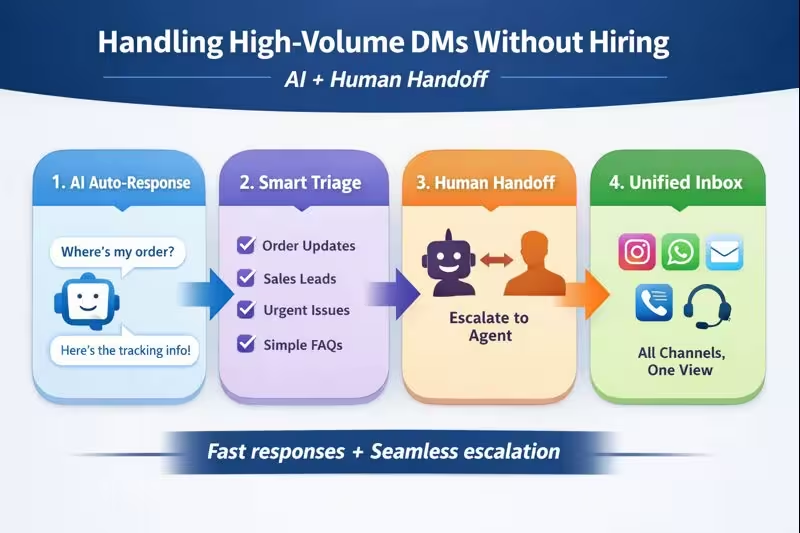
If your Instagram DMs are exploding, you’re not “bad at customer service”—you’re just running a support channel that was never designed to be a ticketing system.
The good news: you don’t need to hire a bigger team to keep up.
You need a repeatable DM operating system:
- AI handles the predictable questions instantly
- Humans take over only when it matters
- Everything runs through one omnichannel workflow, so nothing gets lost
This guide shows you exactly how to do it—using an AI agent plus a clean human handoff (the part most teams miss).
Quick voice-search answer: The fastest way to handle high-volume DMs is to auto-triage and answer FAQs with AI, route urgent or high-value conversations to a human, and track everything in a unified inbox with clear rules and response-time targets.
Why high-volume DMs break teams (even great ones)
DM overload usually comes from a mix of:
- Sales questions (pricing, availability, shipping)
- Support questions (order status, refunds, troubleshooting)
- Spam + “quick questions” that still demand replies
- Channel chaos (Instagram + WhatsApp + website chat + email)
When everything lands in one messy stream, three things happen:
- Response times spike
- Customers double-message (making it worse)
- Your team burns time on repetitive answers
A unified inbox helps, but it’s not enough by itself. Here’s a common example of centralized inbox workflows: HubSpot Conversations Inbox overview.
What you actually want is automation + escalation.
The DM scaling framework: AI-first, human-when-needed
Step 1: Categorize every DM into 4 buckets
This one change makes everything else easier to automate.
1) FAQ (AI should answer 80%+)
Examples:
- “Where’s my order?”
- “Do you ship to X?”
- “What are your hours?”
- “How do I reset my password?”
Goal: AI resolves instantly with a friendly, human-like tone.
2) Account-specific (AI can answer if connected to your tools)
Examples:
- Order lookup, tracking, delivery updates
- Booking confirmations
- Membership status
Goal: AI handles the lookup and response—no back-and-forth.
3) High-value (route to sales or senior support)
Examples:
- Bulk orders, partnerships
- Enterprise requests
- VIP customers
Goal: Human response within minutes, not hours.
4) Sensitive / complex (always hand off)
Examples:
- Charge disputes
- Harassment or safety issues
- Legal/privacy requests
- Unhappy customers needing empathy + judgment
Goal: AI escalates immediately with context.
Step 2: Build your DM triage rules (so the right thing happens automatically)
Here’s a proven rule set you can copy.
Priority rules
- Urgent keywords → “refund,” “cancel,” “charged,” “angry,” “scam,” “lawsuit” → human now
- Order-status intent → AI asks for order number/email → resolves or escalates
- Pricing/availability → AI answers instantly, then qualifies lead
- Anything unclear after 2 turns → handoff (don’t let AI guess)
Response-time targets (SLAs)
- High-value leads: under 10 minutes
- Angry / sensitive: under 15 minutes
- Standard: under 1 hour
- After-hours: AI responds instantly + sets expectation (“A specialist will follow up tomorrow”)
For a future-facing view, Gartner has projected that agentic AI will autonomously resolve the majority of common customer service issues in coming years: Gartner press release.
Step 3: Use AI to answer instantly (without sounding robotic)
The difference between a basic chatbot and “customers actually like this” comes down to three things:
- Tone
- Intent detection
- Context
Your AI should:
- Mirror the customer’s tone (calm, friendly, concise)
- Ask one question at a time
- Confirm understanding before taking action
- Offer the next step clearly
Example:
Customer: “Hey, where’s my order? It’s been a week.”
AI (good): “Totally get it—let’s check that now. What’s your order number (or the email used at checkout)?”
Short. Helpful. Human.
If you want this across channels, MessageMind is built to automate conversations on Instagram, WhatsApp, Messenger, SMS, email, website chat, and even voice calls with a human-like AI agent. Learn more about the platform here: MessageMind Platform.
How the AI + human handoff should work (the part that saves you)
A handoff isn’t just “assign to agent.” It should include:
- The full conversation history
- The customer’s intent + sentiment (“upset,” “confused,” “ready to buy”)
- Any data the AI already collected (order number, email, product name)
- Suggested next actions for the agent
That way, the human doesn’t start from scratch—and the customer doesn’t repeat themselves.
If you’re operating across multiple channels, an omnichannel system prevents the “we replied on Instagram but they followed up on WhatsApp” chaos. MessageMind supports omnichannel engagement from one place: MessageMind.
What to automate first (if you’re starting today)
If your DM volume is high, start with these automations because they remove the most repetitive work:
- Order status / booking confirmations
- Shipping and delivery estimates
- Refund policy questions
- Store hours, locations, basic FAQs
- Lead qualification (budget, timeline, needs)
- “Send me pricing” / “How much is it?” responses
- Escalation rules for sensitive cases
If you’re in eCommerce, you can tailor these flows specifically for order-driven support: AI Customer Support for eCommerce.
Common mistakes that make DM automation fail
Automating everything
Some conversations require empathy and judgment. Automate routine; escalate complexity.
Letting AI “wing it”
If the AI is uncertain, it should ask a clarifying question or escalate—not guess.
No training loop
Review escalations weekly, update answers, and expand what AI can handle safely.
No unified inbox
If channels are split across tools, you’ll miss messages and duplicate effort.
Track these metrics (they tell you if it’s working)
You don’t need a fancy analytics stack. Track:
- Median first response time
- Resolution rate by AI (goal: 50–80% depending on complexity)
- Escalation rate (should fall over time)
- Repeat contacts (“customer had to ask twice”)
- CSAT or simple emoji feedback in DMs
These metrics show you exactly where to improve your triage rules and handoff.
Ready to handle high-volume DMs without hiring?
If you’re dealing with hundreds (or thousands) of DMs across Instagram, WhatsApp, Messenger, email, web chat, SMS—or you want to add voice—MessageMind helps you scale without piling on headcount.
Call to action:
- See how it works: Explore MessageMind
- Get a walkthrough: Book a Demo
- Learn about the core system: MessageMind Platform