How Generative AI Is Revolutionizing Customer Service (Trends, Risks & Best Practices)
Generative AI has moved from hype to helpdesk.
In customer service, it’s no longer just answering FAQs — it’s handling real conversations across WhatsApp, Instagram, SMS, email, web chat and even voice calls, resolving issues and driving revenue around the clock.
For CX leaders, the question has shifted from “Should we use AI?” to “How do we use generative AI safely, profitably, and without losing the human touch?”
This guide breaks down what generative AI actually means for customer service, the biggest trends, the risks you need to manage, and practical best practices — with examples of how platforms like MessageMind bring this to life as a human-like AI customer service team. (messagemind.ai)
What is generative AI in customer service?
Generative AI in customer service is software that uses large language models (LLMs) to understand natural language, generate human-like responses, and take actions (like checking orders or booking appointments) across your support channels.
Unlike scripted chatbots that follow rigid flows, generative AI–powered AI agents can:
- Understand messy, multi-part questions
- Pull accurate answers from your knowledge base and systems
- Act on tools (CRM, e-commerce, booking, ticketing)
- Hand off to human agents with full context
For customers, it feels less like “talking to a bot” and more like messaging a trained human who just happens to be extremely fast and always available.
TL;DR definition
Generative AI customer service = an always-on, human-like AI agent that understands, reasons, and acts across channels — not just a smarter FAQ bot.
Why generative AI is transforming customer expectations
1. From “ticket queues” to instant, 24/7 resolutions
Customers are used to real-time messaging. Waiting hours for a reply feels broken.
Generative AI lets you:
- Answer simple and complex queries instantly
- Support multiple time zones without night-shift staffing
- Keep SLAs tight even during spikes (product launches, holidays, outages)
That’s why analyst research shows customer operations are one of the biggest areas of value for generative AI, alongside marketing and sales. (McKinsey & Company)
2. Conversations that feel human, not robotic
Modern AI agents can:
- Mirror brand tone (formal, playful, luxury, etc.)
- Ask clarifying questions instead of guessing
- Show empathy in sensitive situations (cancellations, complaints, delays)
Platforms like MessageMind’s AI customer service platform are built around this “human-like agent” model — not a decision tree with a friendly avatar. (messagemind.ai)
3. True omnichannel support (one brain, many channels)
Customers don’t think in channels. They DM you on Instagram, then reply by email, then call.
Generative AI agents can:
- Maintain context across WhatsApp, Instagram, Facebook Messenger, SMS, email, web chat and voice
- Apply the same knowledge and policies everywhere
- Share conversation history with human agents in one unified inbox
That’s exactly the model used by MessageMind’s omnichannel AI agent, which acts as a single customer service team across all your messaging channels. (messagemind.ai)
4. From cost center to growth engine
With the right setup, generative AI can:
- Recover abandoned carts
- Upsell or cross-sell based on context
- Proactively reach out when a customer is at risk of churning
Research suggests that customer operations and sales/marketing together account for the majority of generative AI’s economic value — meaning support is no longer just about cost reduction. (McKinsey & Company)
Key generative AI customer service trends to watch
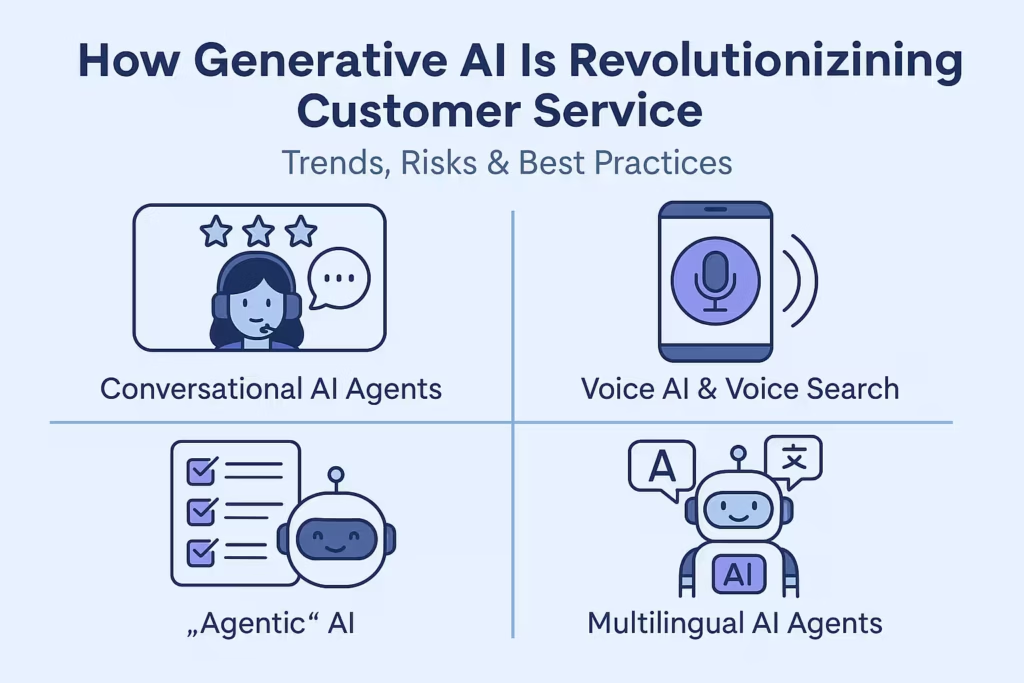
Trend 1: Conversational AI agents become the new front line
Customer service leaders are rapidly piloting or rolling out customer-facing generative AI. One recent survey found that around 85% of service leaders plan to explore or pilot conversational generative AI for customer interactions by 2025. (Gartner)
What this means in practice:
- AI agents take the first pass on most chats, emails and calls
- Humans handle edge cases, VIPs and escalations
- Both share the same context and knowledge
Voice-search / AEO angle: Customers increasingly ask full questions like “How do I cancel my booking?” instead of clicking menus. Your AI agent must understand and answer those natural language queries directly.
Trend 2: Voice AI & voice search become standard support channels
Voice is making a comeback — powered by AI.
Recent reports show billions of voice assistants in use globally, with roughly one in five people using voice search, and more than half of users saying they use voice search to gather information about brands and businesses. (DemandSage)
For customer service, this looks like:
- AI answering and routing phone calls
- Customers asking “Where is my order?” or “Can I change my appointment?” out loud
- Voicebots resolving routine calls end-to-end, with human handoff for complex cases (Verloop.io)
VSO implication: The same content that powers your chatbots and help center needs to be written so it sounds natural when read aloud by a voice assistant.
Trend 3: “Agentic” AI that doesn’t just reply — it acts
The next wave of generative AI doesn’t stop at composing answers. It:
- Looks up order or booking details
- Updates addresses or contact information
- Issues refunds or applies credits within defined policies
- Schedules or reschedules appointments
Industry research highlights this kind of agentic AI as a key focus area, especially in retail and service operations. (TechRadar)
In platforms like MessageMind, that means your AI agent can, for example, pull order status from your e-commerce system and send a WhatsApp update, without a human touching the ticket. (messagemind.ai)
Trend 4: Multilingual AI agents as the default for global CX
Customers expect to be served in their own language. But hiring full teams across every geography is expensive.
Modern generative AI agents can:
- Understand and respond in dozens of languages
- Maintain brand voice across markets
- Apply the same business rules globally
That’s why many platforms — including MessageMind — emphasize multilingual AI agents that can support international audiences without multiplying headcount. (messagemind.ai)
Trend 5: CX leaders own AI strategy (not just IT)
Analyst predictions for 2024–2025 highlight a shift: CX and customer service leaders are increasingly responsible for driving generative AI adoption, not only technical teams. (actioner.com)
That means:
- Defining which journeys to automate
- Owning quality, guardrails and brand alignment
- Using AI data (intents, sentiment, deflection) to inform product and operations decisions
Real-world use cases of generative AI in customer service
Use case 1: Pre-sale conversations & lead qualification
Generative AI can:
- Greet visitors on your website or WhatsApp
- Ask qualifying questions (“What are you looking for?” “When do you need it?”)
- Suggest relevant products or packages
- Book demos or appointments directly in your calendar
This turns your AI agent into a 24/7 SDR for inbound traffic — especially powerful in high-intent channels like WhatsApp and Instagram DMs.
Use case 2: Order, booking & account support
Common flows that generative AI handles extremely well:
- “Where is my order?”
- “Can I change my delivery address?”
- “I need to reschedule my appointment.”
- “I want to upgrade my plan.”
With the right integrations, your AI agent can:
- Authenticate the customer
- Fetch data from your e-commerce, booking, or billing systems
- Take the requested action
- Confirm the outcome in clear, human-like language
Platforms like MessageMind support e-commerce, booking and payment integrations so the AI agent can resolve rather than just respond. (messagemind.ai)
Use case 3: Post-sale retention, reviews & upsell
After a purchase or visit, generative AI can:
- Proactively check in (“How was your stay?” “How did the service go?”)
- Ask for feedback or reviews
- Suggest add-ons (“Would you like to add cleaning?” “Want to extend your subscription?”)
- Detect risk signals in language and route to a human retention specialist
This is where AI starts to drive lifetime value and loyalty, not just cost savings.
The hidden risks of generative AI in customer service
Generative AI is powerful — but not risk-free. Here are the main issues to manage.
Risk 1: Inaccurate or “hallucinated” answers
LLMs can sometimes generate plausible but incorrect responses, especially if:
- They aren’t grounded in your latest policies or inventory
- Customers ask about edge cases or exceptions
- The model is allowed to improvise beyond its permissions
How to reduce this risk
- Ground the AI in your own content (help center, policies, product docs)
- Use retrieval-augmented generation and tool calls instead of free-form “guessing”
- Limit the AI’s scope: define what it can’t answer (e.g., legal, medical, financial advice)
Risk 2: Brand voice & tone drift
Even a correct answer can feel wrong if it’s off-brand — too casual, too harsh, or too robotic.
How to reduce this risk
- Provide explicit tone and style guidelines to your AI agent
- Review real conversations weekly and fine-tune prompts and examples
- Use features that let you “coach” the AI the way you’d coach a human agent (a core design principle of MessageMind’s “Onboard, Measure, Coach” model). (messagemind.ai)
Risk 3: Privacy, security & compliance concerns
Generative AI can touch sensitive data — from payment details to health or legal information.
Regulatory-focused research emphasizes that CX gains from generative AI will only materialize if organizations handle data, consent and AI outputs responsibly. (actioner.com)
How to reduce this risk
- Ensure your provider offers data isolation, access controls and audit logs
- Define what counts as sensitive topics and automatically escalate to humans
- Keep clear records of how decisions are made and logged
Risk 4: Workforce impact & change management
High-profile cases show companies using AI to dramatically reshape their support headcount and operating model. In some scenarios, thousands of support roles have been automated, with AI handling a large share of interactions. (TechRadar)
Handled poorly, this can damage trust internally and externally.
How to reduce this risk
- Frame AI as an assistant, not a replacement: offload repetitive tasks so humans focus on complex, emotional work
- Invest in upskilling agents to work alongside AI (QA, coaching, prompt design)
- Communicate clearly with teams about the goals, metrics and guardrails for AI
Best practices for deploying generative AI customer service
H2-style overview: Your implementation roadmap
Think of your AI agent like a new hire: you onboard, measure and coach it over time.
Below is a practical roadmap you can adapt to your stack and industry.
1) Start with 1–2 high-value journeys
- Pick journeys with high volume and clear success criteria, e.g.
- Order status
- Booking changes
- Basic pricing & plan questions
- Measure before/after: First Contact Resolution (FCR), CSAT, Average Handle Time (AHT), deflection rate
2) Centralize your knowledge
- Clean up FAQs, macros, policy docs and internal notes
- Store them in a structured, searchable format (help center, docs hub)
- Make sure your AI platform can index and reason over this content — not just follow flows
This is also where Answer Engine Optimization (AEO) comes in: write help articles as questions + short, direct answers so search engines, AI assistants and your own AI agent can all reuse the content.
3) Design for hybrid AI + human handoff
- Define clear handoff rules:
- Keywords or intents that must go to humans
- Sentiment thresholds (e.g., high frustration, complaints)
- High-value or high-risk actions (refunds above a certain amount, regulated content)
- Give agents full context: chat history, AI summary, previous actions taken
4) Think voice-first & conversational
To optimise for voice search and voice support (VSO):
- Use headings that mirror how people actually talk, like:
- “How do I change my booking?”
- “Can I talk to a human?”
- Put a one-sentence answer immediately after the question, then additional detail
- Avoid jargon; write in short, clear sentences that sound natural when read aloud
You can see an example of this “voice-first, question-first” writing style across the MessageMind blog.
5) Set guardrails & policies
- Define allowed actions (e.g., issue refunds up to $X, reschedule appointments up to Y times)
- Block categories where AI must not give advice (legal, medical, financial, etc.)
- Configure escalation paths and error handling (“I’m going to connect you to a human specialist for this.”)
6) Monitor performance like you would a human team
Track:
- Automation rate / deflection
- CSAT or NPS for AI-handled interactions
- FCR, AHT, time to first response
- Escalation reasons and patterns
Platforms like MessageMind highlight ROI metrics such as increased automated resolution rate and cost savings, so CX leaders can see real business impact rather than just “bot usage.” (messagemind.ai)
7) Iterate weekly: “coach” your AI agent
- Review a sample of conversations each week
- Tag good and bad responses
- Update knowledge, prompts and guardrails based on real failures
- Treat your AI agent as an evolving team member, not a static project
For a deeper dive into the difference between AI agents and traditional chatbots, you can explore:
👉 AI Agent vs. Scripted Chatbot: What’s the Real Difference?
FAQs about generative AI in customer service (for SEO, AEO & VSO)
These Q&A snippets are written the way customers actually speak — ideal for featured snippets, answer engines and voice search.
Q1. Is generative AI going to replace human customer service agents?
Short answer: No — but it will change what human agents do.
Generative AI is best at repetitive, low-complexity tasks and fast information retrieval. Humans are still better at complex judgment, high-emotion situations and relationship-building. The winning model in 2025 and beyond is a hybrid team: AI handles volume; humans handle nuance.
Q2. How is generative AI different from a traditional chatbot?
A traditional chatbot follows pre-built flows and simple rules; it often breaks when customers go off-script.
Generative AI agents:
- Understand intent in natural language
- Use memory and context across turns
- Pull in real-time data from your systems
- Take actions (not just send links)
That’s the leap from “replying” to “resolving”.
Q3. How can small businesses afford generative AI customer service?
You don’t need an enterprise budget.
Many platforms (including MessageMind) offer:
- Tiered pricing aligned to conversation volume
- All-in-one coverage across channels (WhatsApp, Instagram, email, SMS, web)
- Built-in integrations and templates to get started quickly
The key is to start with one or two high-impact journeys and measure ROI early — things like reduced support hours, increased conversion, or lower response times.
Q4. How do I know if my generative AI customer service is working?
Look at a mix of efficiency and experience metrics:
- Efficiency: FCR, AHT, deflection rate, cost per interaction
- Experience: CSAT, NPS, complaint rates, review scores
- Business impact: conversion uplift, lower churn, higher repeat purchase rate
If those metrics are improving while your human team has more time for complex work, your AI strategy is on track.
How MessageMind brings generative AI customer service to life
MessageMind is an AI customer service platform with human-like agents that work across WhatsApp, Instagram, Facebook Messenger, SMS, email and voice calls.
With MessageMind, CX teams can:
- Onboard an AI agent using their own docs, FAQs and brand guidelines
- Measure its performance with clear analytics and ROI metrics
- Coach it over time to match the best human agents on the team (messagemind.ai)
The platform also offers:
- Deep integrations with e-commerce, booking and other tools
- An omnichannel inbox for AI + human collaboration
- Support for multilingual, voice and image-based interactions
If you’re moving from “scripted chatbot” to true generative AI customer service, MessageMind is designed to be that upgrade path.