When Should Businesses Use AI vs Human Agents?
Customer service is no longer a question of whether to use AI—but when to use it, and when not to.
As AI-powered chatbots, automation tools, and virtual agents become mainstream, many businesses struggle with the same dilemma: Should customer interactions be handled by AI or by humans? The truth is, the best customer experiences don’t come from choosing one over the other—they come from knowing where each performs best.
This article breaks down when businesses should rely on AI, when human agents are essential, and how the smartest teams combine both.
Understanding AI in Customer Service
AI in customer service refers to systems that can understand, respond to, and act on customer requests without constant human involvement. These systems typically include:
- AI chatbots and virtual assistants
- Automated ticket routing and triage
- AI-powered voice agents
- Sentiment analysis and intent detection
- Workflow and response automation
Platforms like Zendesk, Intercom, Freshdesk, and newer AI-first tools like MessageMind all apply AI differently—some focus on automation efficiency, others on conversational intelligence.
When Businesses Should Use AI Agents
AI excels in situations where speed, scale, and consistency matter more than emotional nuance.
1. High-Volume, Repetitive Requests
If your support team answers the same questions repeatedly, AI is the obvious choice.
Examples:
- “Where is my order?”
- “What are your business hours?”
- “How do I reset my password?”
AI can resolve these instantly, reducing wait times and freeing human agents for more complex work.
2. 24/7 Customer Support Expectations
Modern customers expect help anytime, anywhere.
AI agents:
- Never sleep
- Respond instantly
- Handle multiple conversations simultaneously
This makes AI ideal for global businesses or teams that can’t afford round-the-clock human staffing.
3. Initial Customer Triage
AI is especially effective as a first-line support layer.
It can:
- Identify intent
- Collect relevant details
- Route conversations to the right department
By the time a human agent joins, the context is already clear—leading to faster resolutions and less frustration.
4. Multichannel and Omnichannel Support
Managing messages across live chat, email, WhatsApp, Instagram, or web chat can overwhelm human teams.
AI systems can:
- Centralize conversations
- Maintain context across channels
- Ensure consistent responses
This is where modern AI-driven platforms like MessageMind focus heavily—connecting AI logic across multiple communication channels rather than isolating it in a single chatbot.
When Human Agents Are Still Essential
AI is powerful—but not human.
There are moments where empathy, judgment, and creativity are irreplaceable.
1. Emotionally Sensitive Conversations
AI struggles with emotional depth.
Human agents are essential when:
- Customers are angry or distressed
- Issues involve personal or financial hardship
- Trust needs to be rebuilt
Empathy cannot be automated—at least not convincingly.
2. Complex or Unpredictable Problems
AI performs best within defined patterns. When situations fall outside those patterns, human reasoning is critical.
Examples:
- Escalations involving multiple systems
- Unique edge cases
- Policy exceptions
Humans excel at connecting dots AI doesn’t yet understand.
3. High-Value Customers and Relationships
Enterprise clients, long-term customers, and VIP accounts expect personal attention.
In these cases, human agents:
- Build rapport
- Understand long-term context
- Strengthen loyalty
AI can assist—but shouldn’t lead.
AI vs Human Agents: A Simple Decision Framework
If you’re unsure which to use, ask these questions:
Is the request predictable and repeatable?
→ Use AI
Does the customer need emotional understanding?
→ Use a human agent
Is speed more important than personalization?
→ Use AI
Is this a relationship-defining moment?
→ Use a human
Most real-world scenarios fall somewhere in between—which is why hybrid models are winning.
The Hybrid Model: Where AI and Humans Work Together
The most successful customer service teams don’t replace humans with AI—they augment them.
In a hybrid setup:
- AI handles first contact and routine tasks
- Humans handle exceptions, escalations, and emotional moments
- AI continuously learns from human interactions
This approach reduces burnout, improves resolution times, and delivers a smoother customer experience.
Companies using hybrid AI models often see:
- Faster response times
- Lower operational costs
- Higher customer satisfaction
Common Mistakes Businesses Make with AI Support
Even well-intentioned AI adoption can fail if done incorrectly.
Over-Automation
Forcing customers to interact with AI when they clearly need a human creates frustration.
Poor Escalation Paths
Customers should never feel “trapped” inside a bot.
Treating AI as a Cost-Cutting Tool Only
AI should improve experiences—not just reduce headcount.
The goal is better service, not cheaper service.
How AI in Customer Service Is Evolving
AI is moving beyond scripted responses into:
- Context-aware conversations
- Intent-based workflows
- Proactive customer engagement
- AI-assisted human agents
Tools are becoming less visible to customers—but more powerful behind the scenes.
This shift toward “invisible AI” is shaping the next generation of customer experience platforms.
Final Thoughts: It’s Not AI vs Humans—It’s AI With Humans
The future of customer service isn’t about choosing sides.
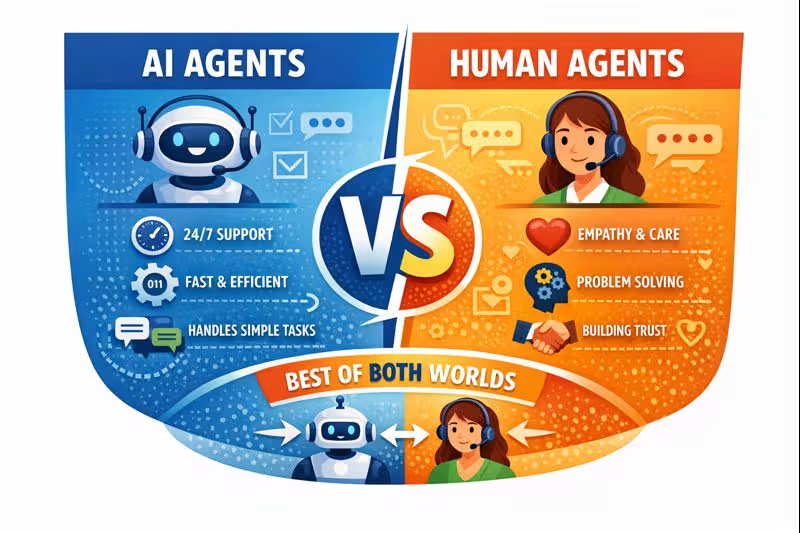
AI is best at speed, scale, and efficiency.
Humans are best at empathy, judgment, and trust.
Businesses that understand this balance—and implement AI thoughtfully—will outperform those that chase automation blindly.
Call to Action
If you’re exploring how AI can support—not replace—your customer service team, it’s worth looking at platforms built around hybrid intelligence and real conversations.
You can explore how MessageMind approaches AI-driven customer communication here:
👉 https://messagemind.ai/
Not as a replacement for humans—but as a system designed to make them better.
