Customer Service Automation with AI: Benefits, Risks, and Real-World Use Cases
In an era where customer expectations are higher than ever, businesses are increasingly turning to AI-powered customer service automation to deliver faster, smarter, and more personalized support. But what does it really mean to automate customer service? And how can you balance the advantages with the pitfalls to create real value for both your customers and your support teams?
Whether you’re a CX leader, a support ops manager, or a business founder exploring automation, this guide will walk you through the benefits, risks, and practical use cases of AI in customer service—without the buzzword fluff.
Why AI Customer Service Automation Matters in 2026
Customer service is no longer just reactive problem-solving. Today, it’s about anticipating needs, reducing friction, and creating experiences that feel effortless.
With tools like MessageMind’s conversational AI (learn more at https://messagemind.ai/), Zendesk’s AI Suite, and Intercom’s Answer Bot, companies are redefining how they support customers.
What Is AI Customer Service Automation?
At its core, automation uses artificial intelligence—like natural language processing (NLP), machine learning, and predictive analytics—to handle customer interactions, route issues, and deliver personalized responses with minimal human intervention.
This can take many forms:
- AI chatbots that answer FAQs
- Automated ticket classification
- Sentiment analysis to prioritize urgent issues
- AI-powered knowledge bases that suggest answers in real time
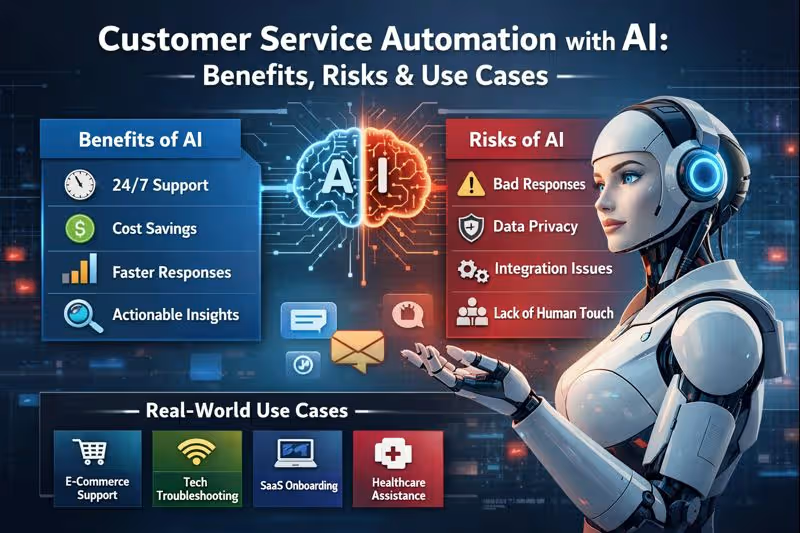
Benefits of Automating Customer Support with AI
1. Faster Response Times
Customers expect instant answers. Automated systems can answer basic queries in milliseconds—boosting satisfaction and reducing churn.
Voice search trigger: How quickly can AI respond to my customer?
This aligns directly with modern search intent. People want quick, concise answers, and AI delivers just that.
2. 24/7 Support Without Extra Staffing
AI doesn’t take breaks.
Your chatbot can handle inquiries after hours, during holidays, and at peak times—giving customers support when they need it and allowing agents to focus on complex issues.
3. Reduced Operational Costs
AI handles repetitive tasks, trimming support costs while improving consistency.
According to industry benchmarks, companies can save up to 30–40% on support operations after automating high-volume queries.
4. Better Agent Experience
By offloading routine work, agents can focus on what matters most—complex problem solving and relationship building.
This improves retention and morale while driving higher first contact resolution (FCR).
5. Insights Through Analytics
AI doesn’t just respond—it learns.
Automated systems collect data, analyze sentiment, and help teams make smarter decisions about product improvements, training gaps, and customer trends.
Real-World Use Cases for AI in Customer Service
AI automation isn’t some futuristic concept—it’s happening now across industries.
Use Case 1: E-commerce Order Support
When customers want order updates, return labels, or delivery timelines, automated systems provide instant responses pulled from real-time data.
Instead of waiting on hold, shoppers get answers immediately—boosting loyalty and conversion.
Use Case 2: Telecommunications Troubleshooting
Telecom customers often reach support for common issues like connectivity troubles or billing questions.
AI can diagnose common problems or guide users through simple fixes, reserving human agents for complex cases.
Use Case 3: SaaS Customer Onboarding
For software platforms, AI helps users get started—answering setup questions, linking to tutorials, and even reducing churn by nudging users toward success.
Use Case 4: Healthcare Support Triage
In regulated sectors like health, automation can pre-filter questions, collect symptoms and direct users to appropriate care or human specialists while maintaining compliance.
Risks and Challenges of Customer Service Automation
While the upside is compelling, there are real pitfalls to navigate.
1. Over-Automation Can Hurt CX
If every interaction is automated without human fallback, customers may feel frustrated or unheard.
Rule of thumb: Use automation to assist—not replace—human empathy.
2. AI Hallucinations and Incorrect Answers
Generative AI can produce confident but inaccurate answers. This risk is especially pronounced if your system lacks real-time access to your support data.
Mitigation strategies include:
- Regular retraining of models on updated support data
- Confidence thresholds that route uncertain queries to human agents
3. Data Privacy and Compliance
Automation systems often process personal data. You must ensure compliance with GDPR, CCPA, and other regional privacy regulations.
Always communicate data use transparently in your privacy policy.
4. Integration Complexity
Seamlessly connecting AI automation with CRMs, billing systems, or order management platforms can be technically challenging. A thoughtful integration roadmap matters.
Best Practices for Implementing AI Automation
Focus on the Customer Journey
Start by mapping common touchpoints. Where are the repetitive pain points? Where do customers wait the longest?
Address these first.
Blend Human + AI Support
The goal isn’t to eliminate agents, but to empower them.
For example:
- AI handles FAQs
- Humans handle exceptions and emotional nuance
Monitor Results and Iterate
Use analytics to measure:
- Customer satisfaction (CSAT)
- Response times
- Escalation rates
Regularly refine your automation workflows.
Choose Tools That Fit Your Stack
Solutions like MessageMind allow flexible integrations with existing CRMs and communication channels, while more templated tools (e.g., Intercom, Zendesk) provide plug-and-play automation.
Voice Search & On-Page SEO: FAQ Section
Here are some common questions customers and voice assistants are likely to ask.
How does AI customer service automation work?
AI uses NLP and machine learning to interpret customer messages and respond intelligently—either with automated replies or by routing to the right agent.
Is AI customer service better than humans?
Not better—but complementary. AI excels at scale and speed, while humans excel at nuance and empathy.
What are examples of AI in customer service?
Examples include chatbots for support, automated ticket tagging, sentiment analysis, and AI search that suggests relevant help articles.
Internal and External Resources to Explore
- Learn more at MessageMind: https://messagemind.ai/
- Explore competitive solutions like Intercom and Zendesk for comparison
- Check AI integration best practices on reputable CX blogs
Linking out to trusted external resources reinforces credibility and improves SEO relevance.
Conclusion: The Future of Support Is Augmented, Not Replaced
AI customer service automation is one of the most impactful investments you can make in support operations today. The key isn’t automation for its own sake—but smart, human-centric automation that accelerates outcomes, protects customer trust, and elevates your brand.
Call to Action
Ready to modernize your customer support with AI that actually works?
👉 Discover how MessageMind can help you automate smarter at https://messagemind.ai/
Let’s build customer service that feels human—even when it’s powered by AI.
